The Backbone of the Nation
KTKonkanya ThepveerakulSome memories stay with us not as images, but as words.
When I was very young, I often heard an old Thai song called Cheewit Kasikorn (ชีวิตกสิกร, “The Life of Farmers”). I may not have fully understood its meaning at the time, but one line stayed with me for years:
“Farmers are the backbone of the nation.”
The song presents agriculture as something fundamental to Thailand — a force supporting the country and its future. As a child, I simply accepted those words. They sounded certain, almost permanent.
But as I grew older, I began to hear them differently.
A Phrase I Carried From Childhood
I had explored the lives of farmers before in my earlier series, Still Feeding the Nation. This time, however, I found myself returning to something different: the language I had carried since childhood.
We use metaphors so naturally that we rarely stop to visualize what they actually say.
So I began with a simple question:
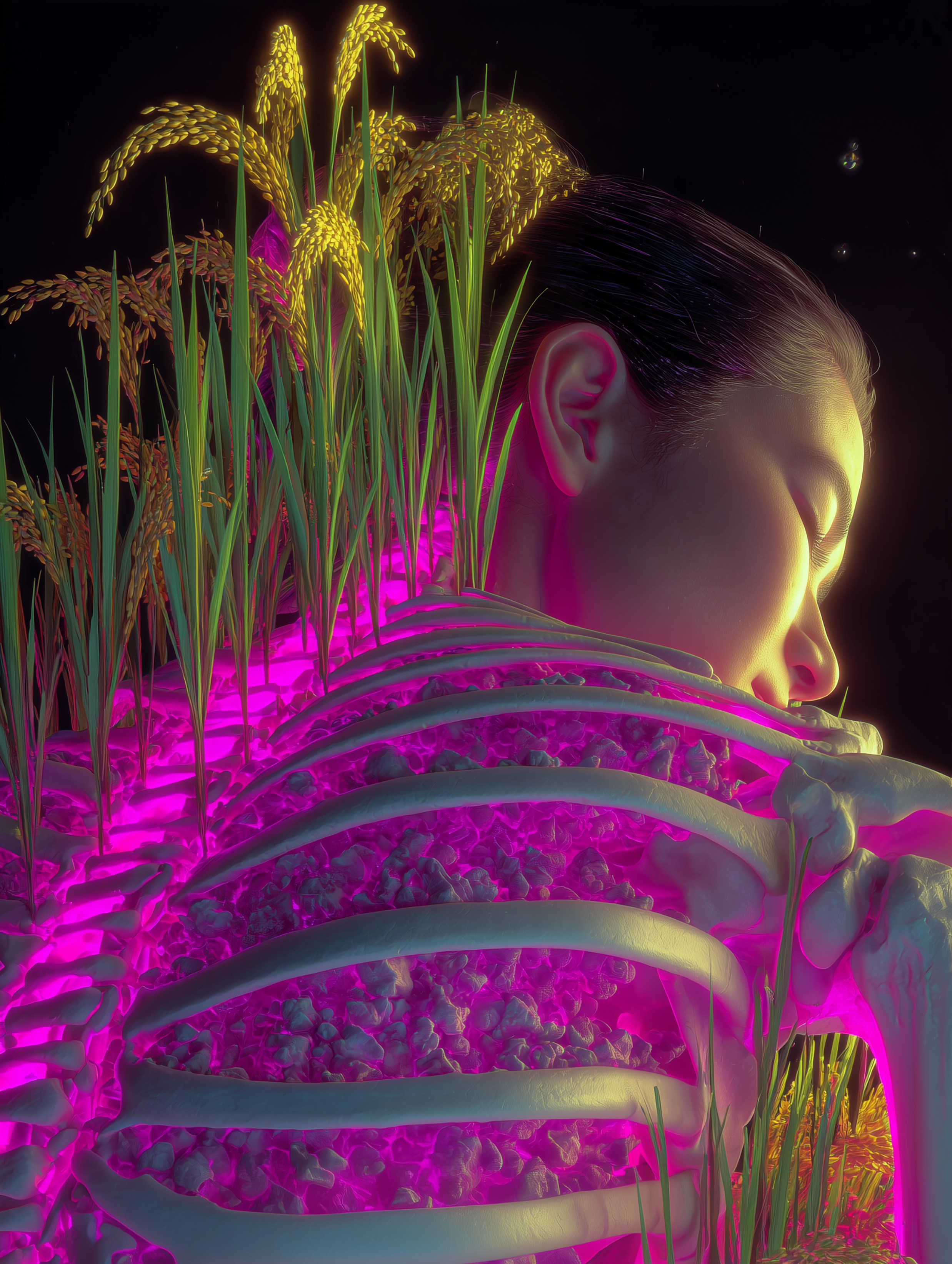
What if “the backbone of the nation” were no longer a metaphor?
What if the human spine literally became the structure supporting agriculture?
What if rice did not simply grow from the earth, but directly from the body carrying it?
That question became the starting point for this series.
When Language Becomes Anatomy
Through AI, I began transforming this familiar expression into something physically impossible.
The human body becomes agricultural land. Rice emerges from the back. The rib cage and spine become visible beneath the harvest. Gradually, the boundaries between human, skeleton, soil, and crop begin to disappear.
I was not interested in creating a literal portrait of a farmer. I wanted to visualize the image hidden inside the language itself.
For me, the exposed skeleton is not simply an image of suffering. It is the metaphor made visible.
If someone is called the backbone, I wanted to show the backbone.
If agriculture rests upon that backbone, I wanted the harvest to grow directly from it.
Returning to an Old Song
There is something strange about returning to a song from childhood as an adult.
The words have not changed.
But I have.
A phrase that once sounded simple now leaves me with questions I never thought to ask when I was young.
What does it mean to call people the backbone of a nation?
And what happens when the body doing the carrying becomes almost invisible beneath what it supports?
I do not want these images to provide an answer. Instead, I want them to make the familiar phrase visible again — so that perhaps we can look at it differently.
AI as a Visual Translator
This is one of the possibilities of AI that continues to fascinate me as an artist.
A body can become landscape.
A skeleton can become architecture.
Rice can grow from a spine.
Language can become anatomy.
For me, AI is not only a tool for generating images. It can become a kind of visual translator — transforming memory, language, cultural expressions, and metaphors into forms that have never physically existed.
Perhaps this is why I returned to Cheewit Kasikorn after all these years.
The song remained the same.
But through art, I could finally see the image that had been hiding inside its words since childhood.
The backbone of the nation.
This time, literally.
4 slides
Published slideshow / storyboard